
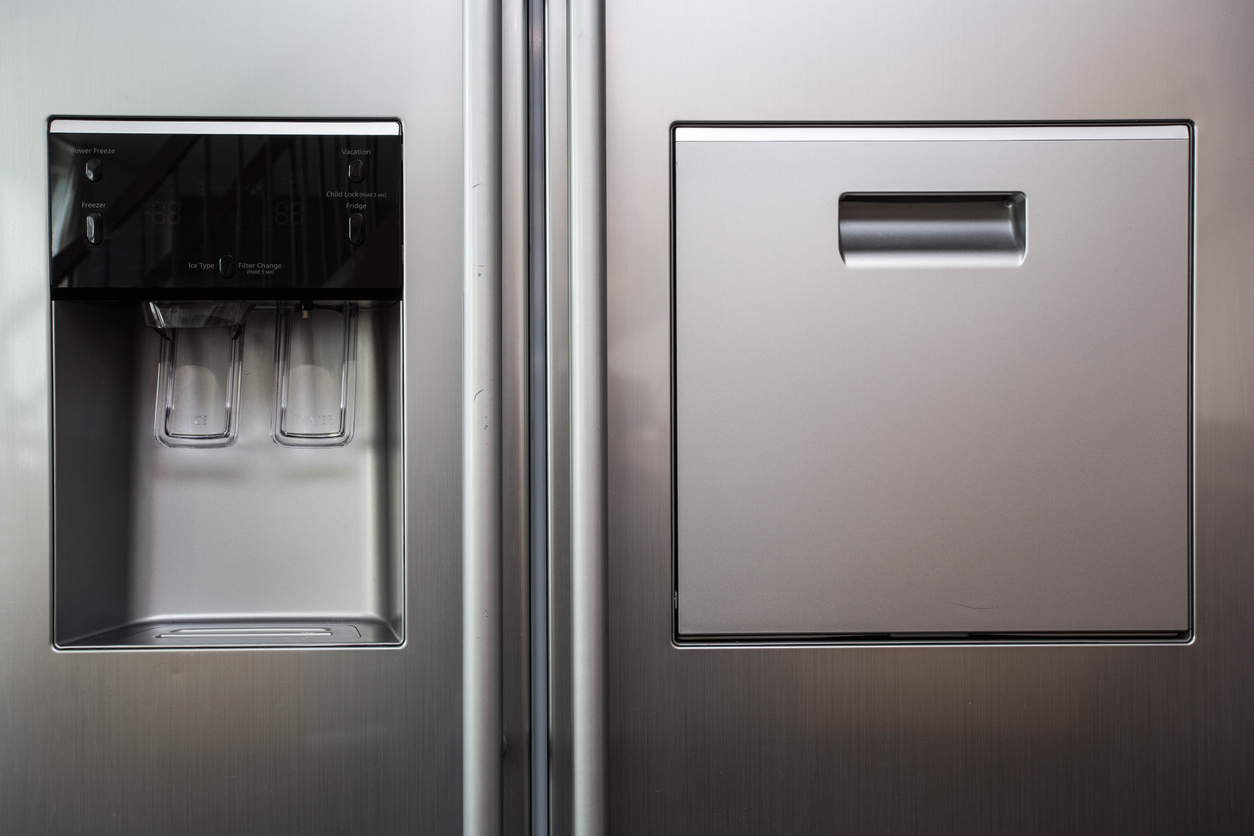
Most refrigerator water filters should be replaced every 6 months, or sooner if the filter reaches its rated capacity (usually about 200 to 300 gallons), the filter indicator light comes on, or water starts dispensing slowly. Large families, heavy ice maker use, and sediment-heavy well water can push that schedule closer to every 3 or 4 months.
The filter is easy to forget because it sits out of sight, but it directly affects the water and ice your household uses every day. Below, you’ll learn what the filter actually removes, the warning signs it’s overdue, how to choose a genuine replacement, and exactly how to change and flush it in about 10 minutes.
Key Takeaways
- Six-Month Replacement Rule: GE, Whirlpool, Samsung, LG, and most other brands recommend a new filter every 6 months or at the rated gallon capacity, whichever comes first.
- Warning Signs to Watch: Slow dispensing, off tastes or odors, small or hollow ice cubes, and a lit indicator light all point to a saturated or clogged filter.
- Certifications Matter: Match your fridge’s filter model number and look for NSF/ANSI 42 and 53 certification to confirm what the filter actually reduces.
- Counterfeits Fail Lead Tests: In independent testing, only 2 of 18 counterfeit filters removed lead for the full six-month filter life.
- Flush and Reset After Installing: Run 1 to 4 gallons through the dispenser, per your filter’s instructions, then reset the filter indicator light.
Shop Genuine Refrigerator Water Filters
Not sure which filter fits your fridge? The specialists at Slager Appliances can match the right genuine filter to your refrigerator model.
What Does a Refrigerator Water Filter Do?
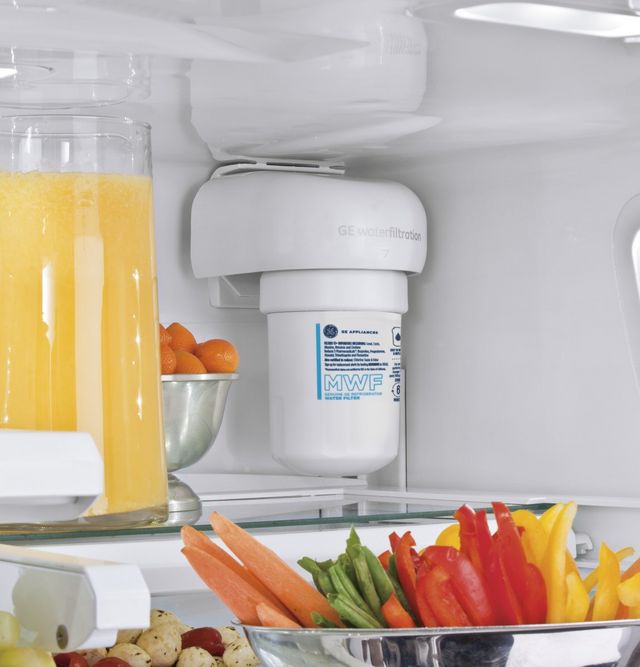
A refrigerator water filter cleans tap water before it reaches your dispenser and ice maker. Nearly all in-fridge filters use a compressed activated carbon block: as water passes through, the carbon’s porous surface traps and adsorbs impurities while the tight block structure physically strains out fine particles.
Depending on its certifications, a refrigerator water filter can reduce chlorine taste and odor, sediment and rust from aging pipes, and specific health-related contaminants such as lead, cysts, and certain pesticides. Health-related claims only apply if the filter is certified to NSF/ANSI 53 for those specific contaminants, while filters certified to NSF/ANSI 401 also reduce some emerging contaminants like certain pharmaceutical residues.
What a Fridge Filter Does Not Do
Standard carbon refrigerator filters are not designed to soften water or remove dissolved minerals like calcium and magnesium, and they are not disinfection systems for bacteria or viruses. If you have hard water or a private well, consider whole-home or under-sink treatment in addition to your fridge filter.
Types of Refrigerator Water Filters
Where your filter sits depends on your refrigerator’s style and age, which also determines how easy it is to swap.
| Filter Type | Where It’s Installed | Typically Found In | Ease of Replacement |
|---|---|---|---|
| Internal Twist-In or Push-In Cartridge | Upper right corner or ceiling of the fresh food compartment | Most French door and many side-by-side refrigerators | Easiest; no tools and minimal spills |
| Base Grille Cartridge | Behind the bottom front kick plate | Older side-by-side and some bottom-freezer models | Easy, but requires kneeling and a towel for drips |
| Inline Filter | On the water supply line behind the fridge | Refrigerators without a built-in filter housing | Harder; requires pulling the fridge out and shutting off water |
| Under-Sink Reverse Osmosis System | Under the kitchen sink, plumbed to the fridge | Homes wanting broader contaminant and dissolved-solids reduction | Separate system with its own filter schedule, not a fridge cartridge |
How Often Should You Replace Your Refrigerator Water Filter?
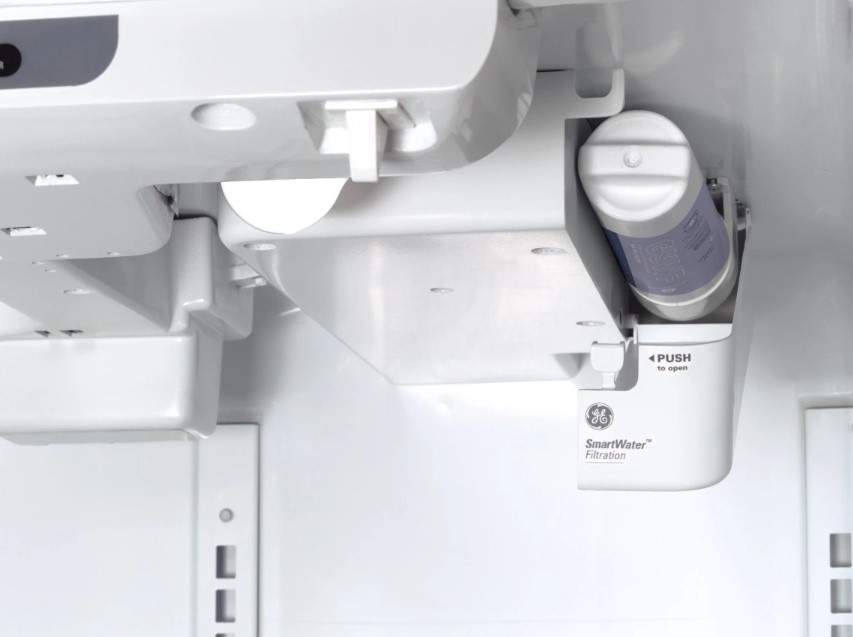
Most manufacturers, including Whirlpool, recommend replacing the refrigerator water filter every 6 months, when the filter indicator light comes on, or as needed. Every filter also carries a rated capacity in gallons, typically around 200 to 300 gallons, listed on the packaging and in the NSF certified product listings. Replace the filter at whichever limit you hit first.
| Your Household | Recommended Replacement | Why |
|---|---|---|
| Typical Household on City Water | Every 6 months | Matches most manufacturers’ standard schedule and rated capacity |
| Large Family or Heavy Ice and Water Use | Every 3 to 4 months, or at rated gallons | High volume saturates the carbon before 6 months |
| Well Water or Visible Sediment | Every 3 to 6 months; watch for slow flow | Particles clog the carbon block faster |
| Rarely Use the Dispenser or Ice Maker | Still every 6 months | A wet carbon filter can grow bacteria over time even with little use |
| New Home or Used Refrigerator | Replace immediately | You can’t know how old the current filter is |
Tip: Write the install date on the filter with a marker or set a recurring 6-month phone reminder. Many filter indicator lights run on a timer, not on actual water quality.
7 Signs Your Fridge Water Filter Needs Replacing
Even before the 6-month mark, your refrigerator will often tell you the filter is spent.
- The Indicator Light Is On: A red or orange light, or a “Replace Filter” message, means the filter’s timer or usage counter has run out.
- It’s Been Over 6 Months: Carbon capacity declines with time and volume, even if the water still looks clear.
- Water Dispenses Slowly: Weak or sputtering flow usually means the filter is clogged with sediment.
- Off Tastes or Odors: A chlorine, metallic, or musty taste in water or ice signals saturated carbon.
- Small, Hollow, or Cloudy Ice: Restricted flow starves the ice maker, and ice production may slow or stop.
- Black Specks or Particles: Debris in water or ice points to an aging or failing filter (on a brand-new filter, it’s loose carbon that flushes out).
- Leaks Around the Filter Housing: Drips can mean a worn seal, an incorrect filter, or one that isn’t fully seated.
➜ Learn More: Refrigerator Not Cooling: Tips, Facts & Answers
What Happens If You Don’t Change Your Refrigerator Water Filter?
Skipping filter changes lowers water quality, gives bacteria room to build up, and makes your refrigerator’s water system work harder.
Water Quality Declines
Activated carbon has a limited capacity. Once its pores are saturated, it can no longer reduce the contaminants it was certified for, so your water may be closer to unfiltered tap water than you think.
Bacteria Can Build Up
Carbon filters remove the chlorine that city water utilities add to keep bacteria in check, and the filter stays wet inside a dark housing. A study of refrigerator water dispensers in 10 Knoxville, Tennessee, homes found no detectable chlorine residual in dispensed water and average bacterial plate counts thousands of times higher than in the same homes’ tap water. Appliance manufacturers cite this kind of bacterial growth as a key reason to replace filters about every 6 months regardless of how they seem to perform.
Your Refrigerator Works Harder
A clogged filter restricts water flow, which can lead to slow dispensing, low or stopped ice production, small or hollow cubes, and added strain on the water inlet valve. A worn or poorly fitting filter can also cause leaks.
How to Choose the Right Replacement Filter
Refrigerator filters are not universal. Even within one brand, different refrigerators use different filters; GE Appliances, for example, uses several filter models across its GE, GE Profile, Café, and Monogram refrigerators. Find your model number on the old filter itself, in your owner’s manual, or by looking up your refrigerator’s model number on the label inside the fresh food compartment.
What NSF/ANSI Certifications Mean
Certification covers only the specific contaminants listed for that filter model, so verify claims in the NSF certified product database.
| Certification | What It Covers | Example Contaminants |
|---|---|---|
| NSF/ANSI 42 | Aesthetic effects; the baseline for nearly all fridge filters | Chlorine taste and odor, particulates |
| NSF/ANSI 53 | Specific health-related contaminants | Lead, cysts, certain VOCs and pesticides |
| NSF/ANSI 401 | Emerging and incidental contaminants | Some pharmaceuticals, herbicides, and pesticides |
| NSF/ANSI 372 | Lead-free filter materials | Lead content of the filter itself |
Genuine vs. Third-Party vs. Counterfeit Filters
Counterfeit refrigerator filters are common on online marketplaces and often copy brand logos and NSF marks. In independent testing commissioned by the Association of Home Appliance Manufacturers (AHAM), only 2 of 18 counterfeit filters removed lead for the full six-month filter life, and some added contaminants to clean water.
| Decision Variable | Genuine (OEM) Filters | Certified Third-Party Filters | Counterfeit Filters |
|---|---|---|---|
| Fit With Your Refrigerator | Designed and tested for your model | Usually fits; check compatibility lists carefully | May fit poorly and leak |
| Certifications | Typically NSF/ANSI 42 and 53, sometimes 401 | Often NSF/ANSI 42 only; verify in NSF, WQA, or IAPMO databases | Fake or copied certification marks |
| Lead and Health-Contaminant Reduction | Certified for listed contaminants | Only if certified to NSF/ANSI 53 for that contaminant | Most failed lead reduction in AHAM testing |
| Upfront Cost | Highest | Lower | Lowest, but with real risk |
| Who It Suits | Households prioritizing verified water safety and fit | Budget-minded buyers who check certifications | No one; avoid |
Buying from an authorized appliance dealer like Slager Appliances is the simplest way to make sure you get a genuine filter.
How to Change Your Refrigerator Water Filter Step by Step
Changing a refrigerator water filter takes about 5 to 10 minutes and no tools. Steps vary slightly by model, so keep your owner’s manual or the filter’s instructions handy.
Step 1: Locate the Water Filter
Check the upper right corner inside the fresh food compartment, the ceiling of the fridge, the base grille at the bottom front, or the water line behind the refrigerator.
Step 2: Prepare the Area
Have a towel ready for drips. For base grille or inline filters, or if your manual says so, shut off the water supply valve first.
Step 3: Remove the Old Filter
Open the filter cover if there is one. For twist-in filters, turn the filter counterclockwise about a quarter turn and pull it straight out. For push-button filters, press the release button and slide the filter out. Expect a small amount of water to spill.
Step 4: Install the New Filter
Remove the packaging and protective caps. Insert the new filter in the same orientation as the old one, then twist it clockwise or push it in until it locks into place. If it doesn’t seat easily, don’t force it; double-check that you have the correct model.
Step 5: Flush the New Filter
Flushing removes trapped air and loose carbon dust. Place a large container under the dispenser and press the lever for 5 seconds on, then 5 seconds off, until water flows steadily. Continue until you’ve dispensed the amount listed on your filter’s instructions, typically 1 to 4 gallons. Cloudy water or black specks at first are normal and should clear. If your fridge has no dispenser, discard the first three batches of ice.
Step 6: Reset the Filter Indicator
Reset the filter light so it tracks the new filter. On many models, you press and hold the “Filter Reset” or “Water Filter” button for about 3 seconds; check your manual for the exact method.
Step 7: Let the Water Chill
Allow up to 24 hours for dispensed water to get fully cold and for the ice maker to refill. Then write the install date on the filter or set your 6-month reminder.
➜ Learn More: What Size Refrigerator Do I Need?
Explore Refrigerators at Slager Appliances
Ready for an upgrade? Compare refrigerators from GE Profile, Café, Monogram, and more in person at our Iowa City showroom.
Frequently Asked Questions About Refrigerator Water Filters
Every 6 months for most refrigerators, or sooner if you reach the filter’s rated gallon capacity (typically about 200 to 300 gallons), the indicator light comes on, or water flow slows.
An expired filter stops reducing contaminants effectively, water and ice can develop off tastes or odors, bacteria can build up in the saturated filter, and the clogged filter can slow water flow and ice production.
It’s possible. A saturated filter no longer reduces contaminants like lead, and carbon filters remove the chlorine that limits bacterial growth, so bacteria can accumulate in an old filter. Replacing it every 6 months and using the dispenser regularly reduces this risk.
Yes. A clogged filter can restrict water flow enough that the ice maker produces small, hollow cubes or stops making ice altogether. Replacing the filter is one of the first things to check when ice production slows.
Most filters call for 1 to 4 gallons, depending on the model. Dispense in 5-second bursts until water flows steadily and the full amount listed on your filter’s instructions has run through.
Cloudy water is usually trapped air, and black specks are loose carbon dust from the new filter. Both are harmless and clear up after you finish flushing the filter.
Yes, on most models. The light usually runs on a timer, so it won’t turn off on its own. Press and hold the filter reset button (often about 3 seconds) or follow your owner’s manual.
No. Filters are brand- and often model-specific, even within the same brand. Match the filter model number from your old filter or owner’s manual.
Some third-party filters are legitimately certified, but many carry fewer certifications than the original, and counterfeits are common online. If you buy a non-OEM filter, confirm its claims in the NSF, WQA, or IAPMO certification databases.
Generally no. Standard carbon refrigerator filters are designed for chlorine, taste, odor, and specific certified contaminants. Fluoride reduction and water softening require dedicated systems such as reverse osmosis or a water softener.
Some refrigerators require a bypass plug to dispense water without a filter, and others won’t dispense at all without one. Check your owner’s manual. Running without a filter means your water and ice are unfiltered tap water.
Why Trust Slager Appliances?
Founded over 70 years ago, Slager Appliances is a family-owned, independent appliance retailer based out of Iowa City, IA. Slager has competitive prices and industry knowledge in delivering and installing all major appliance brands. Large enough to offer competitive pricing yet small enough to continue offering the “white glove” service we pride ourselves on, our focus is always on the customer experience — from the first step into a showroom to the purchase transaction to well after your new appliance has been installed.
Whether you need to replace an old appliance, or if you’re remodeling and need an entire kitchen full of new brand-name products we are with you all the way. We will work with you to find a product that fits your needs, budget, and lifestyle.
Shop Refrigerator Water Filters at Slager Appliances
Don’t put off until tomorrow what you can do today, and shop genuine refrigerator water filters online at Slager Appliances. Our friendly experts are always happy to help you find the right filter for your fridge— whether you call us at 319-337-3833, email us, or use our online chat feature. Better yet, stop by any of our Slager Appliances in Iowa City, IA. Visit us today!
➜ Learn More: French Door Refrigerator Pros, Cons, & Top Picks